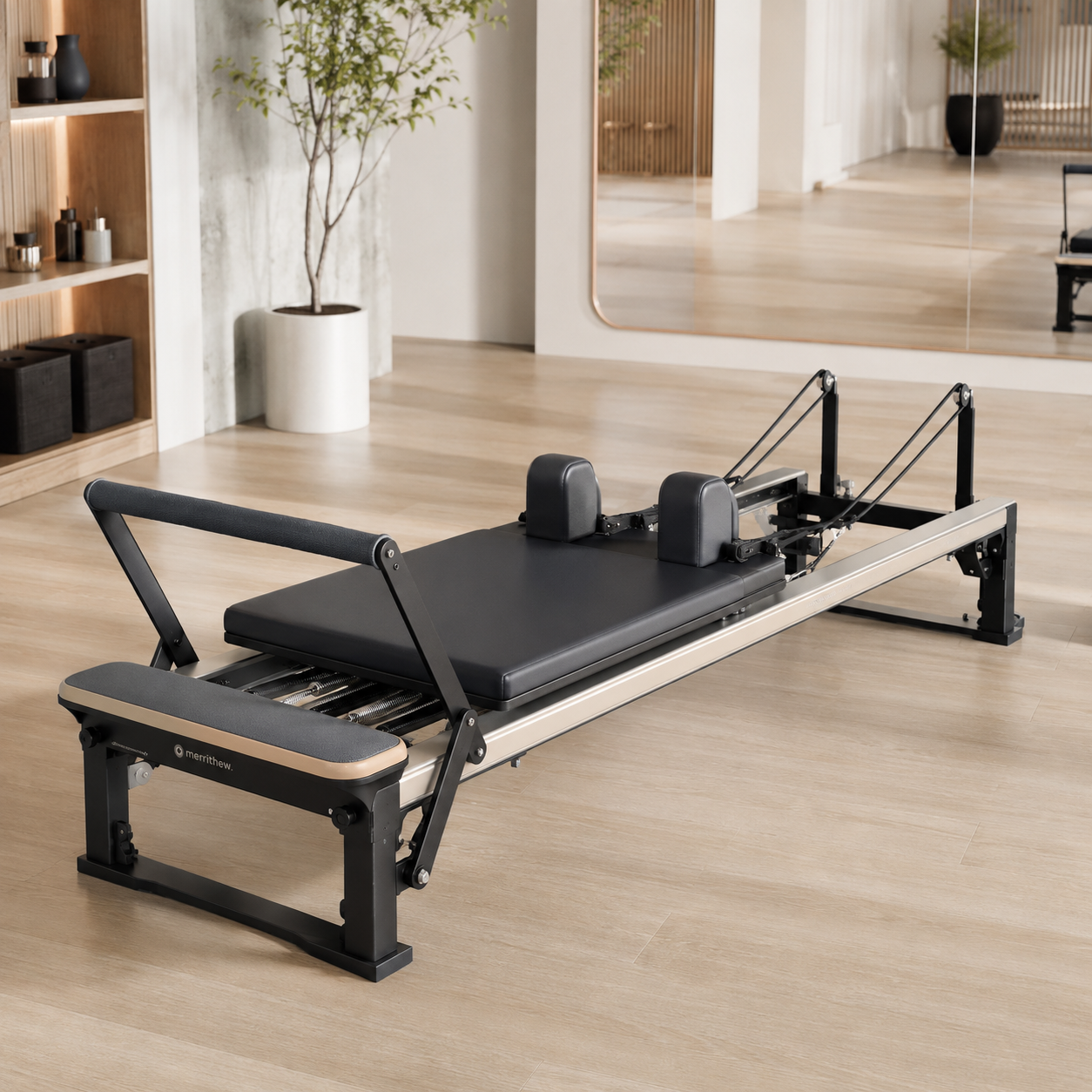
A Pilates reformer can transform the way you approach strength, mobility, flexibility and controlled movement. Unlike conventional exercise machines that usually train the body through a limited movement pattern, a Pilates reformer can support hundreds of exercises performed while lying, sitting, kneeling, standing or working from a plank position.
The machine uses a sliding carriage, adjustable springs, straps, pulleys and a footbar to create resistance or assistance. This combination allows beginners to learn controlled movement while giving experienced users enough variety and resistance to complete challenging full-body workouts.
Whether you are considering studio classes or purchasing a Pilates reformer for home, understanding how the machine works will help you choose the right training approach and equipment.
What Is A Pilates Reformer
A Pilates reformer is a specialised exercise machine originally developed as part of the Pilates method. Its central feature is a padded carriage that moves backwards and forwards along rails within a stable frame.
Springs connect the carriage to the frame and provide adjustable resistance. The user moves the carriage by pressing against the footbar or pulling the straps attached to the pulley system.
The resistance does not always make an exercise harder. In some movements, the springs support the body and make the exercise more accessible. In others, lighter spring resistance requires greater stability because the carriage becomes less controlled.
This combination of support, resistance and instability makes the Pilates reformer highly adaptable. Exercises can be modified for different body sizes, fitness levels, mobility limitations and training objectives.
How A Pilates Reformer Works
The design of a Pilates reformer encourages controlled movement rather than momentum. The carriage responds immediately to the force applied through the arms, legs or torso, making poor control easier to recognise.
Several major components work together during a session.
Moving Carriage
The carriage is the padded platform on which many exercises are performed. It travels along rails using wheels or roller bearings.
A smooth carriage allows the user to move continuously without sudden resistance or vibration. Commercial and premium home machines generally provide longer carriage travel, stronger frames and more refined tracking systems.
Resistance Springs
Springs create adjustable resistance between the carriage and the stationary end of the Pilates reformer. Different combinations can be selected according to the exercise and the user’s ability.
Heavier resistance may make pushing exercises more demanding while providing additional stability. Lighter resistance can make balance and control exercises harder because the carriage is easier to move accidentally.
Adjustable Footbar
The footbar provides a stable surface for the hands or feet. It may be positioned at different heights and angles to accommodate different exercises and body proportions.
A secure locking mechanism is important because the footbar must remain stable when significant pressure is applied.
Straps And Pulleys
Straps connect the user to the pulley system and allow resistance to be applied through the hands or feet. They are frequently used for arm exercises, leg circles, hip work and coordinated full-body movements.
The pulley height and rope length may be adjustable on higher-quality machines.
Shoulder Rests And Headrest
Shoulder rests help keep the body positioned securely on the carriage. The adjustable headrest supports different neck positions during supine exercises.
The headrest may need to remain flat during exercises in which the hips lift above the carriage. Correct positioning should be learned from a qualified instructor.
Pilates Reformer Benefits
Regular Pilates reformer training can develop several physical qualities within the same workout. The precise outcome depends on exercise selection, resistance, frequency and instruction quality.
Full-Body Strength
A Pilates reformer can train the legs, glutes, abdominal muscles, back, shoulders and arms during one session. Many exercises require several muscle groups to work simultaneously rather than isolating one area.
The springs provide progressive resistance throughout the movement. Resistance can be changed as strength and control improve.
Core Control
Core training is a central component of the Pilates method. However, the core involves more than the visible abdominal muscles.
Reformer exercises can challenge the deeper abdominal muscles, pelvic stabilisers, back muscles and muscles surrounding the hips. The moving carriage requires the trunk to remain controlled while the arms or legs move.
Improved Flexibility And Mobility
The carriage and straps can guide the body through a controlled range of movement. Exercises may combine strengthening with active stretching rather than treating flexibility as a completely separate activity.
A Pilates reformer may be particularly useful for people who want to improve movement while maintaining support and control.
Better Balance And Coordination
Standing, kneeling and single-limb exercises require the body to manage an unstable carriage. These movements can develop balance, coordination and awareness of body position.
Beginners should learn these exercises progressively rather than attempting advanced standing movements without supervision.
Low-Impact Resistance Training
Reformer training generally avoids the repetitive impact associated with running and jumping. This makes it attractive to people who want resistance-based exercise without repeatedly striking the ground.
Low impact does not mean low intensity. Spring resistance, slow movement and sustained muscular tension can make a Pilates reformer workout demanding.
Posture And Body Awareness
Pilates instruction commonly emphasises alignment, breathing and movement quality. Users learn to recognise how their ribs, pelvis, shoulders, spine and limbs move in relation to one another.
This awareness can carry over into walking, lifting, sitting and other forms of exercise.
Pilates Reformer Exercises
A Pilates reformer supports a large exercise library. The following categories demonstrate how the machine can be used across different levels.
Footwork
Footwork is commonly performed while lying on the carriage with the feet against the footbar. The user presses the carriage away and returns it under control.
Changing foot position can alter the emphasis across the legs, calves, glutes and hips. Footwork also teaches carriage control and lower-body alignment.
Reformer Leg Circles
The feet are placed in straps while the user lies on the carriage. The legs move through controlled circular patterns against spring resistance.
This exercise can develop hip mobility, abdominal control and coordination. The lower back and pelvis should remain appropriately controlled throughout the movement.
Bridging
Bridging involves lifting the hips from the carriage while maintaining foot pressure against the footbar. Variations may include moving the carriage while the hips remain elevated.
The exercise can strengthen the glutes, hamstrings and posterior chain while challenging spinal articulation and pelvic control.
Arm Work
Straps can be held in the hands for rows, presses, circles, triceps movements and shoulder exercises. These movements can be performed lying, sitting, kneeling or standing.
Because the carriage moves in response to the arms, the abdominal muscles must often stabilise the torso throughout the exercise.
Long Stretch And Plank Variations
Plank-based exercises place the hands on the footbar or carriage while the feet are supported at the opposite end of the machine.
These Pilates reformer exercises can challenge the shoulders, chest, arms, abdominal muscles and hips. They require sufficient wrist, shoulder and trunk control.
Lunges And Standing Exercises
Standing exercises may place one foot on the carriage and the other on the stationary platform. The user controls the carriage while performing a lunge or lateral movement.
These exercises can build leg strength, hip stability and balance but should be introduced carefully.
Jump Board Exercises
A jump board attaches to the end of some reformers and creates a larger platform for the feet. The user can perform jumping movements while lying horizontally.
This allows dynamic leg training with less vertical impact than conventional standing jumps. Not every Pilates reformer includes a jump board, so it may need to be purchased separately.
Pilates Reformer For Beginners
A beginner does not need exceptional flexibility or previous Pilates experience. However, learning the basic setup and movement principles is important.
An introductory session should explain spring selection, carriage control, strap use, footbar adjustment and safe transitions between exercises.
Beginners should prioritise controlled movement rather than attempting the greatest possible range. The carriage should move smoothly without slamming into the end of the frame.
Breathing should remain steady, and resistance should allow the exercise to be completed without losing alignment. A heavier spring is not automatically better, while a lighter spring is not automatically easier.
Studio instruction is valuable during the early stages because an instructor can identify positioning errors that may be difficult to notice alone.
Pilates Reformer Versus Mat Pilates
Mat Pilates uses body weight and gravity as the primary forms of resistance. It is portable, affordable and requires little equipment.
A Pilates reformer adds springs, straps and a moving carriage. These elements can provide more resistance, assistance and exercise variation.
Neither method is universally superior. Mat Pilates can build considerable strength and control, while reformer training may provide greater adjustability and feedback.
Many people combine both methods. Mat exercises develop control without machine assistance, while the Pilates reformer allows users to explore additional movement patterns and resistance levels.
Pilates Reformer Versus Traditional Gym Equipment
Traditional gym machines often isolate a particular muscle group and move through a predetermined path. Free weights allow greater movement freedom but require the user to control the load independently.
A Pilates reformer sits between these approaches. The rails guide the carriage while the straps and body positions allow considerable movement variety.
Reformer training places particular emphasis on smooth transitions, controlled tempo, alignment and coordinated breathing. Traditional resistance training may allow heavier loading and can remain valuable for building maximum strength and muscle.
The best option depends on your objectives. Some users employ reformer training as their primary exercise method, while others combine it with walking, cardiovascular exercise or conventional strength training.
Choosing A Pilates Reformer For Home
Buying a home machine requires more than comparing appearance and price. A Pilates reformer must fit your body, available space, experience level and intended training frequency.
A suitable range of home and studio options can be viewed through the Xpeed Exhale Pilates reformer collection.
Available Space
Measure the entire area before purchasing. Include enough room around the machine to stand beside it, extend the arms and legs, and perform exercises outside the frame.
Consider the machine’s length when fully assembled rather than relying only on packaging dimensions.
User Height And Carriage Length
Taller users may require a longer frame, greater carriage travel and adjustable rope lengths. A machine that feels comfortable for a shorter person may restrict the movement of someone considerably taller.
Check the manufacturer’s recommended user height and test the machine where possible.
Weight Capacity
The maximum user weight should provide a reasonable safety margin rather than merely matching the intended user’s current weight.
A stronger frame may also reduce movement, noise and vibration during demanding exercises.
Spring Quality
Springs affect the feel, resistance range and consistency of the Pilates reformer. Check how many springs are provided, whether they offer different resistance levels and how easily replacements can be obtained.
Springs are wear components and should be inspected regularly.
Frame Construction
Reformer frames are commonly made from timber, steel or aluminium. The material alone does not determine quality because frame design, joints, rails and manufacturing tolerances also matter.
A well-constructed frame should remain stable while the carriage moves quickly or while exercises are performed near the edge of the machine.
Carriage Movement
The carriage should travel smoothly and quietly without wobbling. Uneven movement can interrupt exercise control and may indicate poor tracking or construction.
Roller and wheel quality becomes especially important when the machine will be used frequently.
Adjustability
Look for an adjustable footbar, headrest, shoulder rests, ropes and spring bar. These features make it easier to accommodate multiple users and different exercises.
Quick adjustments are especially useful in studio environments or shared households.
Storage
A foldable Pilates reformer may suit smaller homes, but storage convenience should not come at the expense of stability.
Check the folded dimensions, machine weight, wheel position and whether one person can safely move it. Some full-sized machines can be stored upright, although this should only be done when the manufacturer specifically permits it.
Included Accessories
Common accessories include a sitting box, jump board, platform extender, pole, resistance ring and additional straps.
A cheaper machine may become less economical if essential accessories must be purchased separately. Compare the complete package rather than the base price alone.
Warranty And Support
Check the warranty for the frame, upholstery, carriage components, springs and accessories. Different components may have different coverage periods.
Australian support and accessible replacement parts can make ownership easier. Examine service arrangements before purchasing rather than waiting until a component needs attention.
For buyers comparing complete setups, the available Pilates reformer machines from Xpeed provide options designed for different training environments and requirements.
Home Pilates Reformer Versus Studio Classes
Home ownership provides convenience, privacy and unrestricted scheduling. It may become economical for people who train frequently and would otherwise pay for several classes each week.
However, a home Pilates reformer does not automatically provide instruction. Users need a safe program, suitable resistance choices and an understanding of correct machine setup.
Studio classes provide direct feedback, structured programming and social accountability. Instructors can modify exercises and monitor how clients use the equipment.
A hybrid approach may offer the advantages of both. Initial studio sessions can establish safe technique, while home workouts provide convenience between supervised classes.
Pilates Reformer Safety
Inspect the machine before each workout. Springs, clips, ropes, straps, footbars and carriage components should be secure and free from visible damage.
Keep hair, clothing and fingers away from moving components. Change springs only when the carriage is stable and follow the manufacturer’s instructions for entering and leaving the machine.
Exercises involving standing, jumping or advanced balance should not be attempted simply because they appear easy in a video.
Stop exercising if you experience sharp pain, dizziness, unusual shortness of breath or a loss of control. People managing injuries, pregnancy, medical conditions or significant mobility limitations should obtain appropriate professional guidance.
Maintaining A Pilates Reformer
Wipe the carriage, footbar, shoulder rests and straps after use according to the manufacturer’s cleaning instructions.
Inspect springs for distortion, gaps, corrosion or changes in tension. Springs should be replaced according to the manufacturer’s schedule or sooner when signs of wear appear.
Check ropes and straps for fraying. Examine clips, wheels, rails and adjustment mechanisms regularly.
Keep the carriage rails clean because dust and debris can affect movement. Avoid applying unapproved lubricants, as some carriage systems are designed to operate without them.
A Pilates reformer used commercially will generally require more frequent inspection than a machine used occasionally at home.
Creating A Pilates Reformer Workout Routine
A balanced program should include lower-body work, upper-body resistance, trunk control, spinal movement and mobility.
Beginners may start with two sessions per week while learning technique. Frequency can increase gradually according to recovery, goals and the intensity of other exercise.
Sessions do not need to be identical. One workout might emphasise lower-body strength, while another focuses on mobility, posture and upper-body control.
Progress can involve greater resistance, lighter resistance, slower tempo, increased range, more complex coordination or reduced external support. Adding resistance is only one method of making a Pilates reformer exercise more challenging.
Consistency and movement quality are generally more useful than rushing into advanced exercises.
Frequently Asked Questions
What Is A Pilates Reformer? A Pilates reformer is an exercise machine that uses a sliding carriage, springs, straps, pulleys and an adjustable footbar to provide resistance and support.
Is A Pilates Reformer Suitable For Beginners? Yes. Exercises and spring settings can be modified for beginners, although introductory instruction is recommended.
Can A Pilates Reformer Provide A Full-Body Workout? Yes. A session can train the legs, glutes, abdominal muscles, back, shoulders and arms.
Is Reformer Pilates Low Impact? Reformer Pilates is generally considered low impact because most exercises avoid repetitive ground impact, although workouts can still be physically demanding.
How Often Should Beginners Use A Pilates Reformer? Many beginners start with approximately two sessions per week and adjust their frequency according to recovery and professional guidance.
Is A Home Pilates Reformer Worth Buying? It may be worthwhile when you expect to train regularly, have enough space and can access reliable instruction.
How Much Space Does A Pilates Reformer Need? The required space depends on the model, but you need room for the full machine and enough surrounding clearance to extend your arms and legs.
What Should I Look For When Buying A Pilates Reformer? Consider frame stability, carriage quality, spring resistance, adjustability, user height, weight capacity, accessories, warranty and replacement-part availability.
Can Pilates Reformer Training Build Strength? Yes. Spring resistance and controlled movement can strengthen the entire body, although the results depend on programming and progressive challenge.
Is Pilates Reformer Better Than Mat Pilates? Neither method is automatically better. Mat Pilates is accessible and portable, while a Pilates reformer provides adjustable resistance, support and additional exercise variety.
Can A Pilates Reformer Help With Flexibility? Reformer exercises can combine controlled strengthening with movement through a greater range, which may help develop flexibility and mobility.
Can I Learn Pilates Reformer Exercises From Videos? Videos can support home training, but beginners benefit from qualified instruction to learn setup, spring selection, alignment and safe transitions.
Are Foldable Pilates Reformers Stable? Quality varies. A well-designed folding model may be stable, but its frame, locking mechanisms, weight capacity and carriage movement should be checked carefully.
Do Pilates Reformer Springs Wear Out? Yes. Springs are wear components and should be inspected and replaced according to the manufacturer’s instructions.
Can Tall People Use A Pilates Reformer? Yes, provided the frame length, carriage travel, footbar positions and rope adjustments accommodate the user’s height.
What Accessories Are Useful With A Pilates Reformer? Common accessories include a sitting box, jump board, platform extender, resistance ring and pole.
How Long Is A Typical Pilates Reformer Workout? Sessions commonly range from approximately 30 to 60 minutes, although shorter targeted workouts can also be effective.
Can Pilates Reformer Training Replace The Gym? It can be a primary form of exercise for some people, while others combine it with cardiovascular training or heavier resistance exercise.
Does Heavier Spring Resistance Always Make An Exercise Harder? No. Heavy springs increase resistance in some exercises, while light springs may demand greater balance and carriage control.
How Should A Pilates Reformer Be Cleaned? Follow the manufacturer’s instructions and use products that will not damage the upholstery, rails, springs or frame.
Leave a Reply